
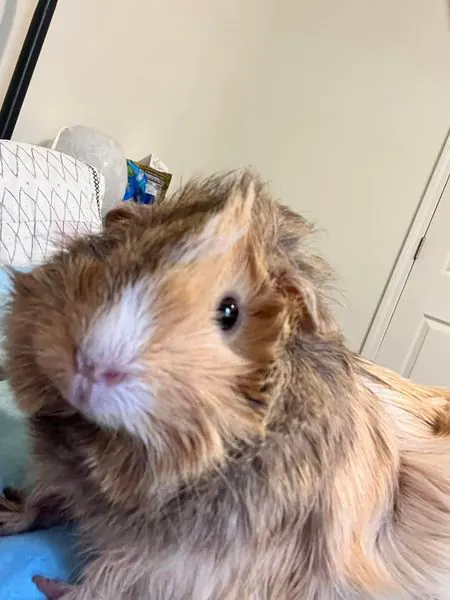
Regular weighing is the single most effective health habit available to guinea pig owners. Because guinea pigs are prey animals that instinctively mask illness, subtle weight changes are often your earliest—and only—warning sign that something is wrong.
Here is how to perform accurate, stress-free weigh-ins at home, what the numbers mean, and how to spot danger zones early.
Tools You Need
- Digital Kitchen Scale: Measuring in grams (or ounces with single decimal accuracy). Grams are much more sensitive to subtle health shifts than pounds.
- Tare Bowl or Container: A wide plastic mixing bowl, cardboard box, or fleece-lined basket to contain squirmy cavies safely.
- Small Veggie Distraction: A sprig of fresh cilantro or parsley to keep your pig occupied while the scale settles.
Step-by-Step Weighing Method
Step 1: Tare Your Scale
Place your bowl or container onto the digital scale and press the TARE / ZERO button. The scale should read exactly 0g with the container on it.
Step 2: Gently Place Your Cavy in the Bowl
Scoop up your guinea pig with two hands, making sure their rear end and feet are fully supported. Lower them gently into the bowl and hand them their veggie treat immediately.
Step 3: Record the Measurement Immediately
Wait 2–3 seconds for the digital number to stabilize, then note the weight in grams.
Normal Healthy Guinea Pig Weight Chart (in Grams & Ounces)
Every guinea pig has a unique natural frame, but the typical healthy weight brackets for domestic cavies are:
| Life Stage / Category | Male (Boar) Range | Female (Sow) Range | Ounces & Pounds Equivalent | Routine Tracking Focus | | :--- | :--- | :--- | :--- | :--- | | Newborn Pup (0–2 weeks) | 60g – 120g | 60g – 110g | 2.1 – 4.2 oz | Daily weigh-ins to confirm steady milk intake | | Weaning Pup (3–8 weeks) | 250g – 450g | 200g – 400g | 8.8 – 15.9 oz | Weekly weigh-ins tracking linear growth | | Juvenile (2–6 months) | 500g – 800g | 400g – 700g | 17.6 – 28.2 oz (1.1 – 1.8 lbs) | Transition toward adult baseline frame | | Healthy Adult (6+ months) | 900g – 1,200g (up to 1,500g) | 700g – 1,100g | 31.7 – 42.3 oz (2.0 – 2.6 lbs) | Establish stable baseline (±0.7 – 1.0 oz weekly) | | Senior Cavy (4+ years) | 850g – 1,150g | 650g – 1,000g | 30.0 – 40.5 oz (1.8 – 2.5 lbs) | Watch for gradual sarcopenia (muscle loss) |
Note: Larger breeds like Cuy or Rex crosses can naturally reach 1,400g–1,800g without being overweight.
The Red-Flag Weight Loss Rule (What the Numbers Mean)
When you weigh weekly at the same time of day, use this veterinary guideline to evaluate shifts:
- ±20g to 30g (0.7 – 1.0 oz) shift: Normal daily fluctuation. Differences in bladder fullness, recent water intake, or hay digestion cause this variance.
- –30g to 50g (1.0 – 1.8 oz) drop: Caution zone. Weigh daily for the next 3 days. Check incisors for overgrowth, inspect water bottle sipper ball function, and monitor pellet consumption.
- –50g to 80g (1.8 – 2.8 oz) drop: Warning red flag. Indicates an emerging problem such as early dental spurs, urinary pain, or subclinical respiratory illness. Contact an exotic vet clinic.
- –80g to 100g+ (2.8 – 3.5+ oz / 10% body weight) drop: Immediate medical emergency. Cavies cannot tolerate prolonged anorexia or GI slowdown. Seek urgent veterinary attention immediately.
How Often Should You Weigh?
- Healthy Adults: Once a week (same morning, before fresh veggies).
- Growing Pups (under 6 months): Once a week to confirm consistent growth.
- Senior or Chronic Care Cavies: Twice a week.
- Sick or Post-Surgery Cavies: Once daily (morning) to catch dehydration or gut stasis.
Frequently Asked Questions
What time of day is best to weigh guinea pigs?
Weigh your guinea pigs at the same time of day once every week, ideally in the morning before fresh vegetables or pellets are distributed. A pig that just ate 50g of moist greens will show an artificially elevated weight.
Can I use a human scale or bathroom scale?
No. Human bathroom scales lack single-gram sensitivity and fail to register small shifts under 100g accurately. Always use a digital kitchen or postal scale with 1-gram precision.
Why is my guinea pig losing weight even though they seem to eat?
This is one of the most common early presentations of dental malocclusion (back molars forming sharp spurs). Cavies may chew hay enthusiastically, but struggle to swallow, dropping pieces or eating far less actual volume than appears.
Sources & Scientific References
- Practical Small Animal Weighing Protocols — Cavy Health & Husbandry Group (Journal of Small Animal Practice, 2023)[View Source ↗]
- Ferrets, Rabbits, and Rodents: Clinical Medicine and Surgery — Quesenberry, K. & Carpenter, J. (Elsevier Health Sciences, 2020)[View Source ↗]